FAQ
What is budgeting and forecasting software? Budgeting and forecasting software helps organizations create financial plans, build forecasts, track performance, and improve decision-making. Unlike spreadsheets, a centralized budgeting platform improves collaboration, reduces manual errors, and provides greater visibility across departments, locations, and entities.
When has an organization outgrown Excel for budgeting? Organizations often outgrow Excel when budgeting involves multiple workbooks, numerous contributors, several departments or locations, manual consolidations, version control issues, or complex forecasting requirements. These challenges can make budgeting less efficient and more difficult to manage accurately.
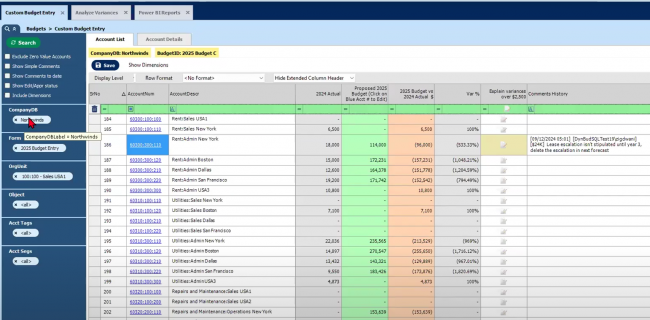
How does Dynamic Budgets help replace Excel for budgeting? Dynamic Budgets helps organizations replace disconnected Excel workbooks with a centralized budgeting, forecasting, and reporting platform. Finance teams gain greater control and visibility while department managers can contribute through a simplified budgeting process without needing advanced spreadsheet skills.
What types of organizations use Dynamic Budgets? Dynamic Budgets is used by healthcare organizations, hospitality companies, restaurant groups, nonprofits, associations, educational institutions, franchise organizations, property management firms, professional sports organizations, manufacturers, professional service firms, and multi-entity businesses.
What is driver-based budgeting? Driver-based budgeting uses operational metrics such as labor hours, patient visits, occupancy rates, enrollment, food costs, sales activity, or production volume to create more accurate budgets and forecasts. This approach helps organizations align financial planning with operational performance.
Can Dynamic Budgets support multi-entity organizations? Yes. Dynamic Budgets supports budgeting, forecasting, and reporting across multiple companies, business units, subsidiaries, departments, locations, and operating entities while maintaining consolidated visibility and reporting.
Can Dynamic Budgets support multi-location budgeting? Yes. Organizations can budget and forecast across multiple facilities, properties, stores, restaurants, clinics, campuses, hotels, regions, or franchise locations while maintaining centralized oversight and reporting.
How does Dynamic Budgets improve budgeting accuracy? Dynamic Budgets improves budgeting accuracy by centralizing financial planning, reducing spreadsheet errors, eliminating manual consolidations, standardizing assumptions, and enabling collaboration between finance teams and operational leaders.
What ERP systems does Dynamic Budgets integrate with? Dynamic Budgets integrates with:
- Oracle NetSuite
- Sage Intacct
- Acumatica
- Microsoft Dynamics 365 Business Central
- Microsoft Dynamics GP
- Microsoft Dynamics NAV
This allows organizations to build budgets and forecasts using trusted financial data directly from their ERP system.
Can non-financial managers participate in the budgeting process? Yes. Dynamic Budgets was designed to make budgeting easier for department managers, operational leaders, and budget owners. Finance maintains control over assumptions, calculations, and reporting, while non-financial users can participate in the planning process without extensive training.
How long does it take to get started with Dynamic Budgets? Unlike many traditional planning solutions that require lengthy implementation projects, Dynamic Budgets helps organizations modernize budgeting quickly, allowing teams to begin improving planning processes in days rather than months.
Why do organizations choose Dynamic Budgets? Organizations choose Dynamic Budgets because it combines powerful budgeting, forecasting, reporting, and driver-based planning capabilities with a user-friendly experience. It helps organizations simplify complex planning processes while avoiding the cost and complexity of traditional enterprise planning solutions.
What industries benefit most from budgeting and forecasting software? Organizations with complex planning requirements benefit the most, including:
- Healthcare
- Hospitality
- Restaurants
- Nonprofits
- Associations
- Education
- Franchise Organizations
- Property Management
- Real Estate
- Professional Sports
- Manufacturing
- Professional Services
- Multi-Entity Businesses + More
Can Dynamic Budgets help organizations with hundreds of budget workbooks? Yes. Dynamic Budgets helps organizations replace hundreds of disconnected spreadsheets and workbooks with a centralized platform for budgeting, forecasting, reporting, and collaboration. This reduces administrative effort, improves visibility, and increases confidence in financial planning.
What is the difference between Dynamic Budgets and spreadsheet budgeting? Spreadsheet budgeting often relies on multiple workbooks, manual consolidations, formula maintenance, and version control management. Dynamic Budgets centralizes planning, improves collaboration, enhances reporting, supports driver-based forecasting, and provides a single source of truth for budgeting and financial planning.